



WHY AIO RADIATOR PLACEMENTS MATTER
Where you mount your AIO liquid cooler’s radiator affects more than just appearance. The wrong placement can reduce CPU cooling performance and, in some cases, shorten the cooler’s lifespan.
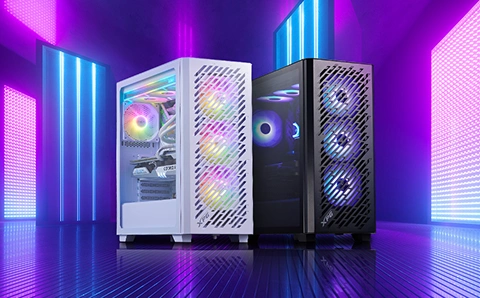
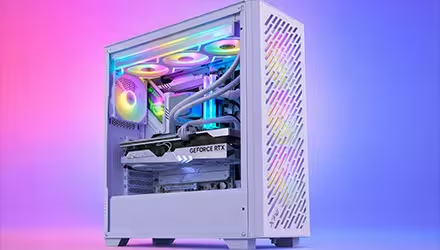
In most modern PC cases, including models like the VALOR AIR PRO, the radiator is typically mounted at either the front or the top. Each position has different effects on airflow, CPU temperatures, and overall system cooling.
FRONT-MOUNTED RADIATOR (INTAKE)
A front-mounted radiator is usually configured as intake, pulling cool outside air through the radiator for better CPU cooling. The downside is that this air is warmed before reaching the rest of the system, which can slightly raise GPU temperatures, so this setup tends to favor CPU-heavy builds.
In fish tank cases, front intake is often replaced by glass and moved to the side. A side-mounted radiator as intake works similarly and offers the same general CPU-cooling advantage.

TOP-MOUNTED RADIATOR (EXHAUST)
A top-mounted radiator is usually set as exhaust, receiving air pulled into the case by front/side intake fans. It pushes warm air exhausted by the GPU out of the case to lower temperatures, making this placement more favorable for GPU thermals.

CHOOSING A PLACEMENT BASED ON YOUR WORKLOAD
For a PC with a high-core CPU used mainly for CPU-intensive workloads like code compilation and many editing workflows, a front-mounted radiator provides better cooling for the processor. The LEVANTE II 360 AIO, with its rated 320W TDP, is suited for such systems and other demanding CPUs.
Gaming or AI PCs that lean heavily on the GPU will benefit from a top-mounted radiator, since it can improve overall case exhaust and help GPU thermals. In this configuration, a build with components like the Ryzen 5 9600X and RTX 5070 will see more balanced CPU and GPU temperatures (though this still depends on case airflow and fan curves).
AIR POCKETS AND LONGEVITY
Even though an AIO liquid cooler is a sealed system, a small amount of coolant may slowly permeate through the tubing and evaporate over time. Depending on tube material and build quality, it usually takes several years – often around five to seven – for this to cause meaningful performance degradation.
As coolant evaporates, it can leave behind an air pocket. Since air has a natural tendency to rise upwards in a liquid, it will settle at the highest point in the AIO loop. Air in the radiator or tubing is not usually harmful by itself, but if it collects in the AIO pump, it can increase noise and accelerate wear.
With a top-mounted radiator, the radiator is typically the highest point in the system, so air pockets tend to settle there and stay away from the pump.
In a front-mounted configuration, it is important to mount the radiator so that at least part of it sits higher than the pump, keeping air pockets in the radiator instead of the pump.