



DIGITAL VS ANALOG PSU: WHICH IS BETTER FOR YOUR PC?
While the quality of a power supply may not directly affect in-game frame rates, it plays a critical role in overall system stability and component longevity. For most users, selecting a PSU based on wattage, efficiency rating, and ATX standard compliance is sufficient. However, for high-end systems, it can also be useful to understand the difference between digital and analog power supplies.
DIFFERENCES IN DESIGN: ANALOG VS DIGITAL
Household power is delivered as alternating current (AC), while PC components require direct current (DC). A PSU converts AC to DC and regulates the voltage supplied to the system. The method used to monitor and control this regulation is what distinguishes analog and digital PSUs.
Most consumer power supplies use traditional analog controllers to manage power delivery. These designs are mature, well-understood, and highly reliable. However, an analog PSU might react more slowly to extreme transient load spikes compared to a digital PSU.
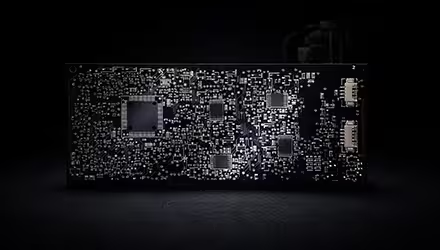
This is because digital power supplies use a microprocessor that monitors and adjusts voltage and current on all rails in real time. This allows for higher levels of efficiency, tighter voltage regulation, and delivers more stable power to components, even under heavy load.
For most entry-level and mid-tier gaming PCs, a well-built analog PSU is more than sufficient. These units can reliably power the newer RTX 40 and 50 series GPUs while offering excellent value and performance comparable to digital PSUs.
WHEN A DIGITAL PSU MAKES MORE SENSE
Those who prefer maximum efficiency and the highest 80 PLUS and Cybenetics ratings may opt for a digital power supply. Digital PSUs offer tighter monitoring and control of voltage behavior, which can be useful if you plan to overclock your PC. Overclocked setups significantly increase power demand and fluctuations, making stable power delivery even more important.
Digital PSUs often include a dedicated port that connects to the motherboard via a USB 2.0 header or an external USB cable. Once connected, this allows software-based monitoring of key metrics such as voltage, current, power, efficiency, and temperature. Some digital PSUs also allow users to adjust fan curves, monitor power rails, and track PSU efficiency over time.
More demanding workstations with multiple GPUs and server-grade processors may benefit from pairing with a fully digital PSU. Its highly stable power output helps prevent damage to these sensitive components from voltage fluctuations that an analog PSU might struggle to handle.
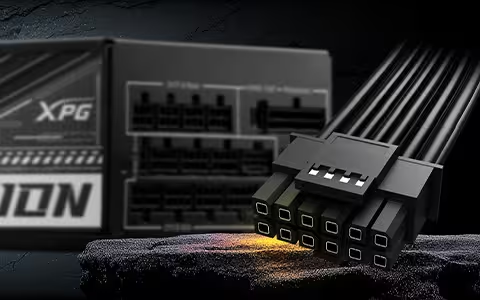
The FUSION 1600 TITANIUM is a solid option for such workstations. With its three microcontroller units (MCUs) managing power control and protections, pairing it with XPG PRIME lets users monitor PSU performance and fine-tune supported settings as needed, helping ensure stable operations under heavy workloads.