



WHAT IS 235% POWER EXCURSION AND WHY IT MATTERS
Modern GPUs like NVIDIA’s RTX 40 and RTX 50 series are constantly testing the limits of the power supply that powers them by periodically demanding short but very large bursts of power. These transient power spikes, also called power excursions, are one of the main reasons why choosing a power supply that is compliant with the ATX 3.1 standard has become increasingly important.
WHY ATX 3.1 MATTERS FOR MODERN GPUS
It is normal for a GPU to briefly draw significantly more power than its rated TDP. This can occur during sudden scene changes while gaming at high resolutions, when rendering scenes in real time using ray tracing, or during demanding AI workloads. Older GPUs also experienced power transients, but because their TDP was lower, the resulting spikes were proportionally smaller. For example, the GTX 1080 Ti had a TDP of 250W, so a short power spike of 500W could typically be handled by a quality 650W or 750W PSU, while still leaving sufficient power headroom for the rest of the system.
Modern high-end GPUs operate at much higher power levels, making their transient spikes correspondingly more demanding. An RTX 5080 has a rated TDP of 360W without overclocking and may briefly draw close to 720W or more during an excursion. Although these spikes often last less than 100 microseconds (0.0001 seconds), they can still place a significant load on the PSU or trigger its protection mechanisms.
WATTAGE ALONE IS NOT ENOUGH
Because of these spikes, simply choosing a high-wattage power supply for your PC is not always sufficient. An older 1200W PSU may interpret a sudden, large power excursion from a modern GPU as a fault or short circuit, triggering its built-in protective mechanisms and cutting power to the system. This can result in stutters or crashes during gaming, freezing during video editing, and random shutdowns during sustained GPU-heavy workloads.
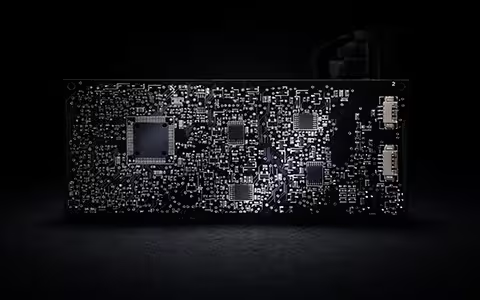
However, a newer PSU that is compliant with the ATX 3.1 standard is designed to handle these sudden power excursions, even at a lower rated wattage. This is achieved through improved power delivery design, including bulk capacitors and faster control response, allowing the PSU to supply short bursts of power when needed.
ATX 3.1 STANDARD REQUIREMENTS
The ATX 3.1 standard, introduced by Intel, requires power supplies to tolerate power excursions of up to 200% of their rated output for up to 100 microseconds. This makes compliant PSUs extremely stable and reliable during sudden load changes, helping to protect and reduce stress on PC components such as the GPU and motherboard.
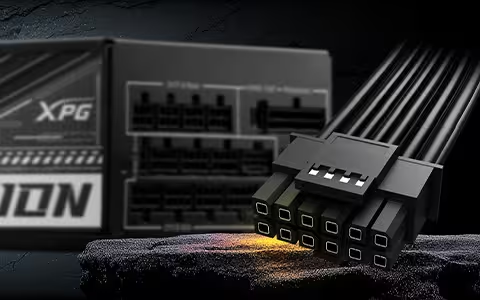
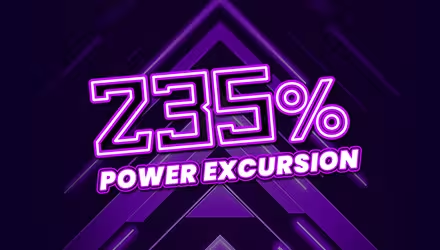
For a high-end PC build with expensive and power-hungry components, it is essential to choose a PSU that not only meets the system’s minimum wattage requirement but is also compliant with the ATX 3.1 standard. All XPG power supplies are engineered to handle power excursion of up to 235%, exceeding the ATX 3.1 standard’s 200% requirement.

FOR HIGH DEMAND BUILDS: FUSION 1600 TITANIUM
The FUSION 1600 TITANIUM, with its Titanium 80 Plus and Cybenetics rating, follows this standard and is a reliable option for such builds especially for local AI computing where power demands can be higher and more sustained. It is designed to tolerate extremely high short-duration transient loads, improving compatibility with even more demanding next-generation GPUs.