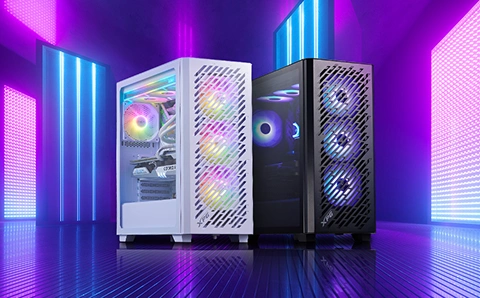




SFF PCS EXPLAINED
Small form factor (SFF) computers used to be niche, but those days are long gone. Today, well-built SFF PCs can rival the performance of full-tower desktops. Here is why they have become so popular.
WHAT IS AN SFF PC? EVERYTHING YOU NEED TO KNOW
Small form factor PCs are essentially regular desktops, just smaller. They typically use mini-ITX or micro-ATX motherboards.
SFF PCs have steadily grown in popularity over the last few years, largely thanks to their versatility. They occupy far less space while still delivering some serious performance.
NVIDIA gave SFF PCs a major boost with its SFF-Ready Enthusiast Program that standardized GPU dimensions for small cases. This ensures that SFF-friendly GPUs are readily available, from mid-tier options to flagship cards.

WHAT ARE SFF PCS BEST FOR?
Whether you are a hardcore enthusiast or a casual user, an SFF PC can be built to fit your needs.
They are used for a wide range of purposes, including casual and competitive gaming, LAN parties and competitions, home offices, home theater PCs (HTPCs), content creation, and even as console replacements.
BENEFITS OF SFF PCS
Size
SFF PCs take up much less space on and under the desk, making them ideal for compact setups. They are especially popular for users with multi-monitor layouts, as it is much easier to fit a compact tower alongside bulky displays.
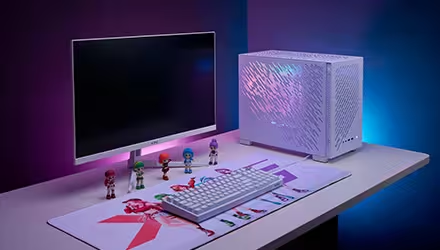
A compact chassis, like the m-ATX-compatible VALOR MESH NANO, can fit almost anywhere, yet still house a powerful system. With support for high-end GPUs up to 370mm, including the NVIDIA RTX 5090 it offers a practical, high-performance alternative to a full-sized rig.
Portability
A smaller footprint means easier transport. It is much easier to pack up a SFF PC for a LAN party or work event than it is to lug around a full-size desktop.
Aesthetics
SFF PCs naturally lend themselves to cleaner, more minimalist setups. Compact cases tend to blend into a room rather than dominate it, making them a great fit for shared spaces.
Versatility
SFF PCs never truly have to "retire." You can build one to serve as a capable gaming PC for years, and if you eventually upgrade, it can be repurposed as a home entertainment hub for your family.
|
Consideration |
Small form factor PC |
Regular-sized PC |
|
Size & footprint |
Very small; fits on crowded desks |
Typically large and heavy |
|
Portability |
Easy to move, pack, or transport |
Large desktops usually remain stationary |
|
Internal space |
Limited space for components and cables |
Plenty of room for parts |
|
Airflow & thermals |
Requires some planning, but can be excellent in a good case |
Easier to achieve good airflow, but still requires planning |
HOW TO CHOOSE YOUR SFF PC
Start by planning your use case. Are you building a high-end gaming rig, a portable workstation, or a home theater PC? Your goal will guide the components you need.
Most SFF builders begin by selecting the GPU, since its size typically dictates which cases are viable. Next, pick a case that fits your desired GPU. A chassis like the VALOR AIR NANO is a versatile choice and works equally well for both high-end and casual builds.
At every step, double-check clearance specifications, including GPU length, height, and thickness, as well as maximum limits for your CPU cooler and PSU.
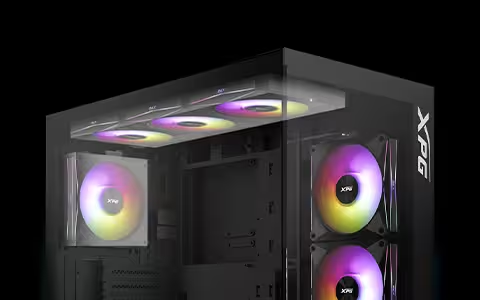
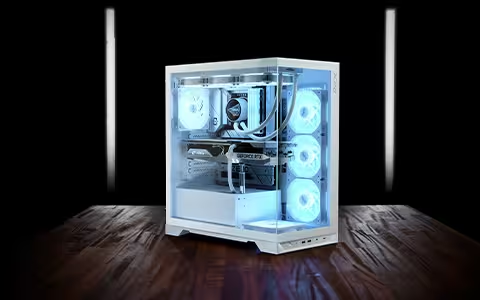
For enthusiast builds, pay attention to airflow. Look for cases with mesh panels, multiple fan mounts that can fit air or liquid cooling options like MAESTRO PLUS 62DA or LEVANTE II 240, and cable management options that allow your components to stay cool. Using a modular PSU, like the PYMCORE SFX, helps reduce cable clutter and keeps the interior organized.